
Heavy-Media Separation (HMS), also known as Dense Medium Separation (DMS), is a gravity-based process that exploits differences in material density to separate valuable minerals from gangue.
At its core, HMS uses a suspension of finely ground high-density solids (such as magnetite or ferrosilicon) in water to form a “dense medium” whose specific gravity lies between that of the valuable and waste materials. According to Archimedes’ principle, when ore particles are immersed in this medium, those denser than the medium sinks, while lighter particles floats.
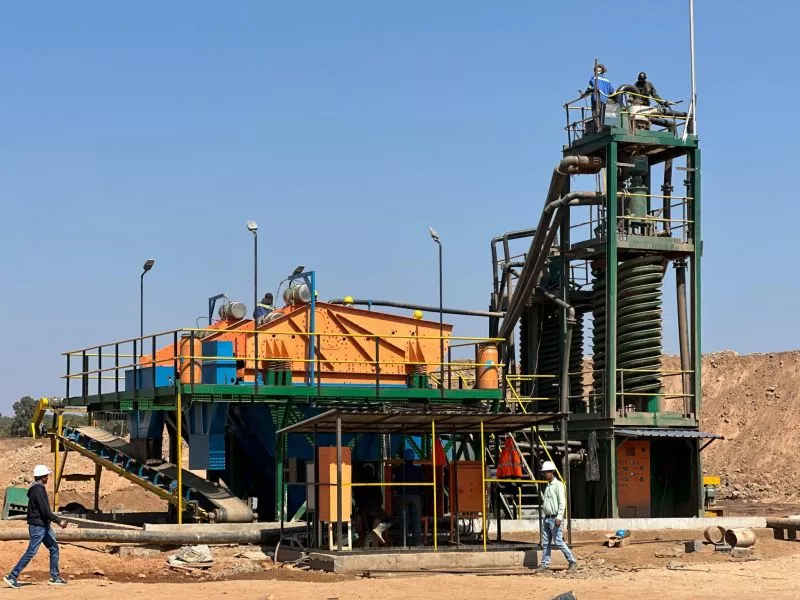
Practically, the ore is crushed and sized, then mixed with the dense medium to form a slurry. This slurry is fed into a separator, a static bath or a dynamic vessel such as a heavy-media cyclone. In a cyclone, centrifugal forces enhance separation: denser particles are thrown outwards and exit through the bottom, while lighter ones are carried upwards.
The choice of medium is critical. Magnetite (specific gravity ~5.1) or ferrosilicon (up to ~6.8) are common because of their high density and recoverability by magnetic separation. The medium’s density is continuously monitored and adjusted using densitometers to maintain the “cut-point”, the specific gravity at which the process separates materials.
Efficiency in HMS depends on how well the valuable minerals are “liberated” (i.e., free from gangue), the stability and control of the medium density, and the recovery circuit to reuse the dense medium. This technology remains widely used in mineral processing (e.g., coal, iron ore, diamonds) because it offers high throughput, good accuracy, and relatively low operating costs.