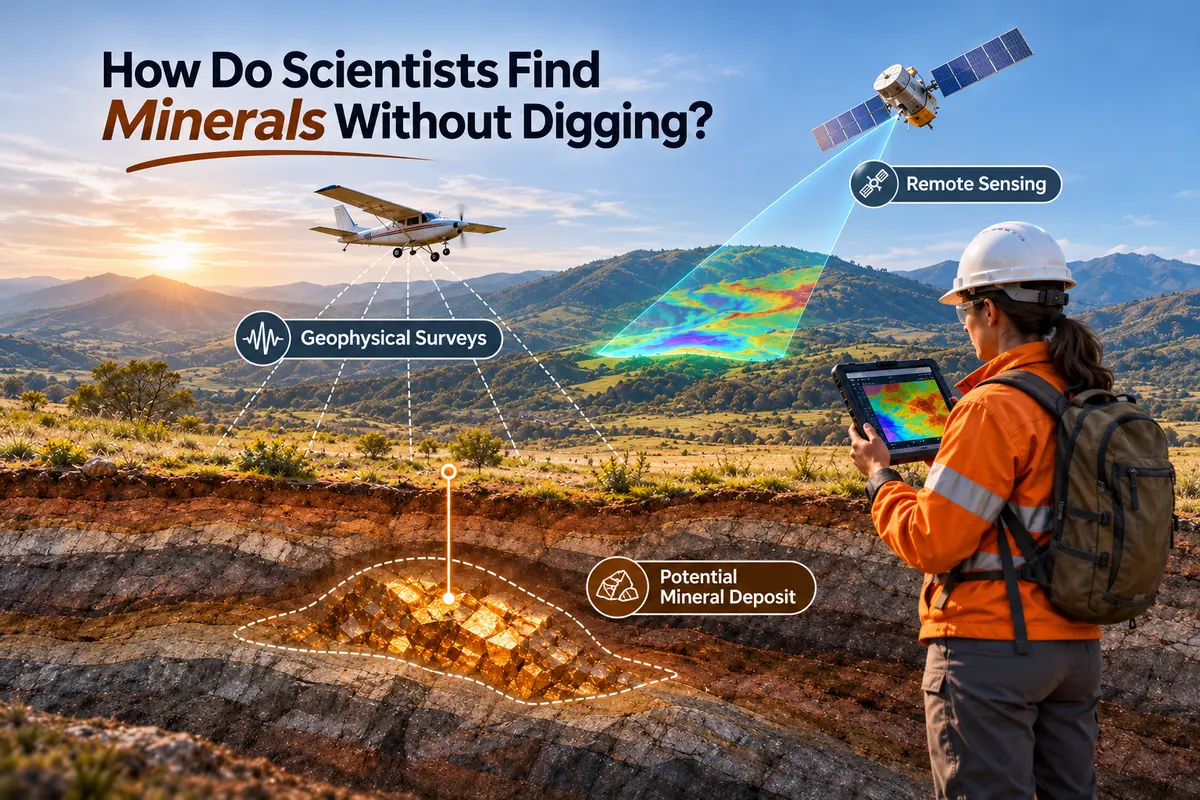

Imagine looking at a vast stretch of land and trying to discover what lies hundreds of meters beneath your feet. There may be valuable mineral deposits hidden beneath layers of ordinary rock, soil, and vegetation. But how do geologists find them without excavating the ground?
The answer lies in geophysics. Scientists use specialized instruments to study the physical properties of rocks beneath the Earth's surface.
According to the US Geological Survey (USGS), “Geophysical mapping allows scientists to understand the composition and structures of rock beneath the Earth’s surface.” These surveys measure variations in magnetic fields, gravity, and electrical conductivity, helping geologists identify geological formations and potential mineral deposits.
As Geoscience Australia explains, magnetic surveys can detect variations in the Earth's magnetic field caused by magnetic minerals in crustal rocks.
Once promising locations are identified, targeted sampling and drilling help verify the findings.
Sometimes, discovering what lies beneath the Earth begins by looking at what is happening above it.