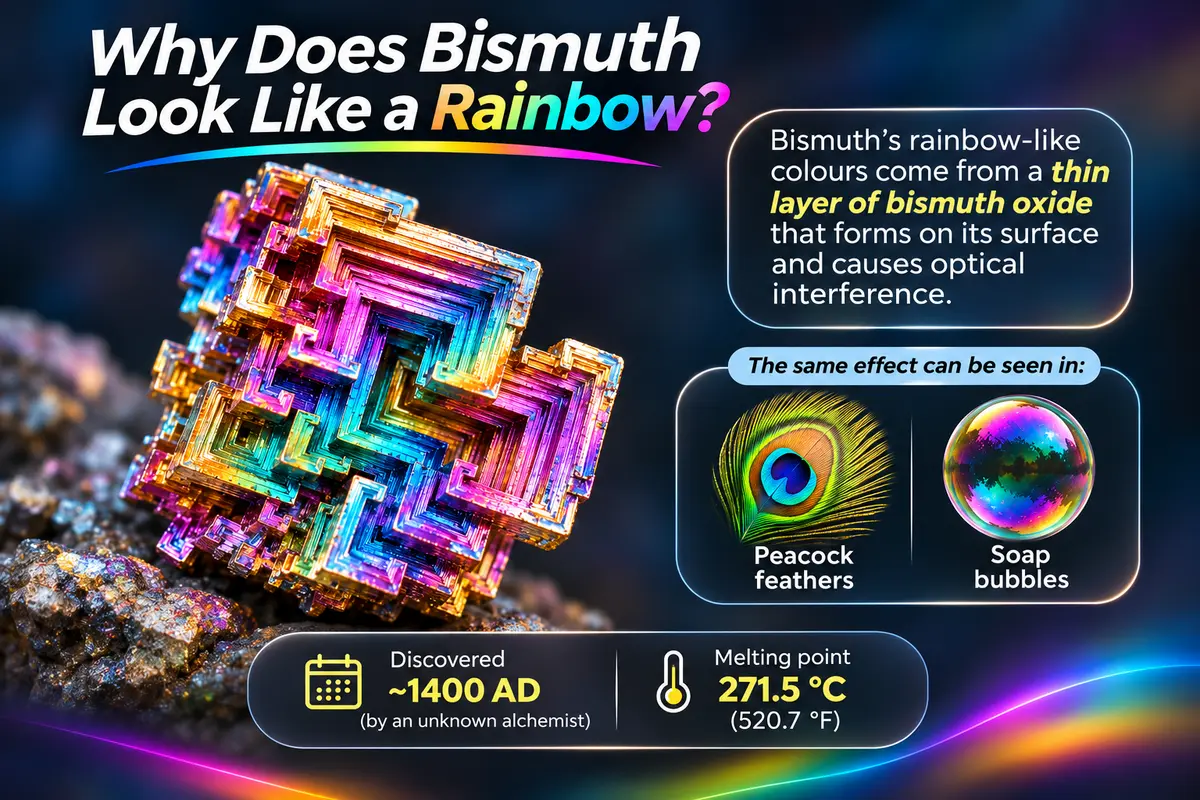

At first glance, bismuth crystals look as though they have been painted in shades of gold, purple, blue, and green. But their extraordinary colours are not the result of paint or pigments. The secret lies in a thin layer of bismuth oxide that forms on the metal's surface as it cools.
Bismuth was discovered by an unknown alchemist around 1400 AD. It is a lustrous silvery metal with a pink tint and a melting point of 271.5 °C (520.7 °F).
When you examine bismuth crystals, you may notice an iridescence effect on their surfaces, similar to the colours seen on peacock feathers and soap bubbles. This effect is caused by a thin film of bismuth oxide that sometimes forms on the crystal surfaces as they cool.
The film is so thin that the light passes through it to the surface of the bismuth crystal and is reflected there. On its way back, it joins the light that is being reflected from the surface of the oxide film. The two light beams interfere with each other. When this happens, certain colours are cancelled out of the white light which contains all the colours of the visible spectrum. When one colour is subtracted, the light no longer remains white but is coloured. So, the surfaces of the bismuth crystals appear coloured.
A thin film of oil on water shows colour in the same way. So do the peacock feathers and the soap bubble. Colours produced in this way are called interference colours.